Monday, May 5, 2014

PFAM Is Here May 19, 2014!

It’s that time of the month again, and this month I’m hosting PFAM.

The question for this month is: How do you cope with transitions?

The last nine months of my life have seen a lot of transitions: I defended my dissertation, received my PhD, moved from Michigan to New York, had to find new doctors, started a new academic pursuit, and am about to finish the first year of that academic pursuit.

Your transition can be in life in general, health-wise, or both.

If you would like to submit a post, e-mail the following to gettingclosertomyself@gmail.com:

Your name (as it should appear)
Your blog’s name
Your post’s title
Your posts’ URL

And make sure you put PFAM in the subject line.

Speaking of transitions, Duncan Cross will be taking back administrative duties for PFAM after this month.  My life has gotten a lot busier since I took over for Duncan, and his schedule has opened up.  I am sad that I am taking a step back, but know that PFAM is in Duncan’s very capable hands.  I do hope that I will get the chance to host, and can hopefully pinch hit for Duncan if and when he needs it. 

All submissions wishing to be considered should be received by 11:59 p.m. on May 16, 2014.

Thursday, April 24, 2014

Social Media And Chronic Illness: Keep Facebook Free For Non-Profits

I am writing this post because CreakyJoints has brought it to the attention of its page followers that Facebook has changed its algorithms, which in this case means that it changes the way pages are seen. 

Because of this change, at most only 1% of page followers will see any given post. 

For example, due to this change, of CreakyJoints nearly 70,000 page followers, at most 700 will be able to see any given post.

For large non-profits that have the budget to pay for Facebook ads, this change won’t really impact them. 

But for smaller non-profits who do not have a budget to pay for Facebook ads, and who rely on their page followers, this change means that their reach is going to be significantly smaller than it used to be (read from 70,000 to only 700). 

CreakyJoints isn’t the only site that will be impacted by this change.  Many of the chronic illness pages that I follow on Facebook will be negatively impacted because of this policy.

Facebook is great in many ways.  It connects people from around the country and world that would not know each other otherwise.  And this can be so critical when dealing with a chronic illness.

But Facebook has certainly struggled over the years with constantly changing privacy policies, and now policies that focus solely on the bottom line rather than on keeping Facebook free for those who need it to be. 

There are Facebook haters everywhere.  There are even “I Hate Facebook” groups on Facebook (which is a little contradictory, but oh well, they do exist). 

So whether or not you hated Facebook before, you might want to hate it now, because it severely limits the posts you will see from the pages that you like, and disregards the needs of non-profits, many of which you may be a supporter of. 

It’s time that we stand up to Facebook collectively, and demand that they change the algorithms so that they don’t disproportionately have a negative impact on non-profit organizations, and in this case, specifically, patient advocacy organizations.   

CreakyJoints has a petition on change.org that has collected over 16,500 signatures in the past two weeks.

25,000 signatures are needed in order for the organization to be able to sit down with Facebook and voice concern about this policy in person.    

For more information about this, or to sign the petition to encourage Facebook to change the algorithm so that it does not negatively impact non-profits, visit: https://www.change.org/petitions/keep-facebook-free-for-non-profits.   

Monday, April 21, 2014

Fitness For Chronic Illness* (And Evaluating My Resolutions Three And A Half Months In)


Recently, Facebook implored me to like a page called “Fitness For Chronic Illness”.  I was intrigued. 

My first thought was, I wish I’d thought of that.  And my second thought was, I have to try it.

The unique thing about this program is that it starts out with visualization exercises, then a workout, then meditation.  It really focuses on the mind-body connection.

I think it’s a great program if you really aren’t able to do much physical activity.  There’s a lot of stretching and a focus on increasing mobility.  I think it’s also great if you are having a flare and need to pull back on what you usually do, or it’s great to do as an additional workout to what you already do.    

The program is designed so that you do one workout for two weeks, the second workout from weeks three to five, and the third workout from weeks six to eight.   

***

As I mentioned in my New Year’s resolutions, a big thing that I want to do this year is get back in to working out.  In Michigan, I was kickboxing once a week for an hour, and doing a 2- and a 3-mile walk aerobics DVD, the 2-mile, one day, and the 3-mile, another.  

So I was working out hardcore three times a week.  With defending my dissertation, then moving, then starting a new program, working out went by the wayside, which is unfortunate because it is critical for people with arthritis to keep moving and stay active.  And it is critical for me in the hope that I will take off some of the weight I have gained from being on steroids for almost a year.   

My current work out consists of:

-         Nightly Crunches
o   50 regular
o   20 with feet in the air
o   25 side-to-side
o   Bridge held for 30 seconds

-         Gym (Twice a week)
o   Walking 2.5 miles – 45 minutes on treadmill
o   Five-pound weights (graduated from three-pound weights)
§  20 bicep curls
§  10 bat wings
§  10 lifting weights over head
§  10 side-to-side
§  10 triceps lifts
§  20 punches
o   20 jumping jacks
o   Plank on elbows held for 30 seconds
o   Plank on hands held for 30 seconds

***
So where does Fitness For Chronic Illness fit into my current workout routine?

I’ve only made it up back up to working out twice a week, so I would love to be able to use it for my third workout of the week, as it is less intense than doing what I currently do, but focused very much on moving around.  

I used to lament having to adapt the workout video that I used to do.  And kind of gave up on it when I went on my unintentional workout hiatus.  But the great thing about this program is that, if you need to modify movements, that is discussed in the program, so it doesn’t make you feel bad about yourself if you can’t do every move as shown.    

You can purchase the DVD for $19.99.  For more information, visit http://www.fitnessforillness.com/.

* My cousin happens to be the co-creator of the program, so I was able to try it for free.  (Although I don’t think that either of us realized we work both working on chronic illness related stuff until we reconnected on Facebook.)

Tuesday, April 15, 2014

My Post-Steroid Life: Stretch Mark Cream And Strap-On Ice Packs

Sounds sexy, right? 

Sometimes RA is so sexy…and soul-crushing.

I’ve been off of steroids for about two months now.  And it has been a struggle.  But I am determined not to go back on them for a long, long time.

Being on steroids is a pain (figuratively).

And being off of steroids is a pain (literally). 

For me, being off of steroids means that I have a significant increase in pain and swelling, especially in my knees and feet.

I haven’t really found a way to deal with the feet pain.  It’s pretty insidious when the bones in your feet hurt. 

For my knee pain, I was really excited to find an ice pack that actually “straps on” with Velcro.  It’s great because I can wear it at night and not worry about it falling off.

Oh, the simple things in life.  Who would have ever thought that an ice pack would be so exciting?    

The other issue I had during this round of steroids, while on Methylprednisolone, which I never had when I was on Prednisone, is that I have stretch marks on my sides and on my under arms just above my armpits. 

Apparently this is something that can happen.  Although, like I say, it has never happened to me before.  It’s also troublesome because I didn’t gain the amount of weight while on steroids that you suspect would cause stretch marks.

They don’t hurt or anything, but they are totally unsightly and embarrassing; luckily they are mostly unseen, although I am constantly aware that they are there. 

I got some stretch mark cream, which seems to be lightening them up a bit, but seems like a product I shouldn’t need at this point in my life.


One thing I do miss about steroids is that they make my shoulders feel so much looser and lighter, like an unbearable weight has been lifted off of them.      

But I obviously don’t miss all of the pesky side effects, and even though I am off of them, I am still trying to get rid of the side effects. 

The whole steroid thing is something that I really struggle with.  Of course I would rather not be in pain than be in pain, if I had a choice.  But sometimes, steroids just feel like more work than they’re worth.

I recently met several women in their 20s who have had to have full hip replacements due to being on chronically high doses of steroids.  This is definitely not worth it to me. 
The prospect of a hip replacement does not thrill me at all.

So I’m going to try and stay off of steroids for as long as I can.  And I’m going to try and complain to a minimal degree while I’m off of them.     

But the reality is, I have seen my body change in myriad ways over the past six years that I have been sick.  And I think it’s a really difficult aspect of being chronically ill that you don’t have control over.  Your body changes – whether from the ravages of the disease, medication side effects, or many other reasons – and you’re helpless to stop it from happening.  You have to sit back and watch it happen.  And so do the people around you. 

When I first got sick, I was so ill, that I would have done anything to get better.  And I have made concessions along the way in terms of telling myself I would never give myself injections to then getting to the point where I did give myself injections.

But I am still on the fence when it comes to steroids.  I’ve made concessions and have gone back on them when I didn’t want to, but they will never be a permanent solution for me.  Finding that permanent solution is something I’m not sure I will ever find.     

Sometimes I feel like when you’re chronically ill, it’s expected that you’ll evolve and not worry about superficial aspects of yourself.  Like if steroids are helping my pain, I shouldn’t be worried or annoyed that I’ve gained weight and feel fat. 

But the truth is, one of the most stunning aspects of being chronically ill is looking in the mirror and not recognizing the person that is staring back at you, whether the lack of recognition is due to literal or figurative changes.

I try to be realistic about my situation.  I try to focus on the positive.  And I try to cut myself some slack when my illnesses or medications change my body.  But sometimes it’s more frustrating than being in (literal) pain.   

Monday, April 7, 2014

Taking A Vacation From My Vacation

That sounds totally weird, right?  Taking a vacation from a vacation.

But when you’re chronically ill, sometimes that has to happen.

I recently traveled to California, and upon returning to New York, I felt like I needed to recover.

Don’t get me wrong.  The vacation was great and very relaxed.

And yet, staying up for almost 24 hours between leaving New York and going to sleep in California, two-, six and a half hour flights, and a three hour time change, is a lot for my body to handle. 

Thankfully, I was with people who were more understanding than most.  We didn’t plan any activities that would be super strenuous or taxing, but I still needed to pace myself. 

Saturday afternoon I took a nap, which was much needed since we had plans in the evening.  Sunday we drove to Sonoma, so that was pretty relaxing.  And Monday we explored San Francisco. 

Lately, I’ve felt like I am flaring.  Like really.  Which hasn’t happened in a while.

I’ve been totally exhausted, to the point that I was when I first got sick.  I’m in a lot of pain.  And most recently, I’ve had the tell tale pain under my right rib. 

And I don’t want to blame it on vacation.  Because if you can’t sit back and relax when you are on vacation, when can you?

It seems like getting back into my daily routine of activity and commuting has hit me really hard.  I definitely needed a vacation from that – and in that respect – I don’t think my vacation was long enough.

In reality, vacation is a word I haven’t seen in a while, and it was a much needed break. 

But it has made me realize that I need to re-evaluate things.  I need to have a contingency plan.  I need to figure out how much vacation time I need after a vacation. 

Does it matter if it’s a car trip versus a train trip versus a plane trip? 

Does it matter if I end up in a different time zone? 

Does it matter if I’m traveling alone or with other people?

Again, don’t get me wrong.  The vacation was totally worth it.  We saw good people, ate good food, and soaked up some much needed sun that we hadn’t seen in about four months during the eternal winter we’ve been having.      

So if you’ve been wondering where I’ve been, blog-wise, I was on vacation, and then since then, I have been recovering from my vacation.

Friday, March 21, 2014

My ID Square*

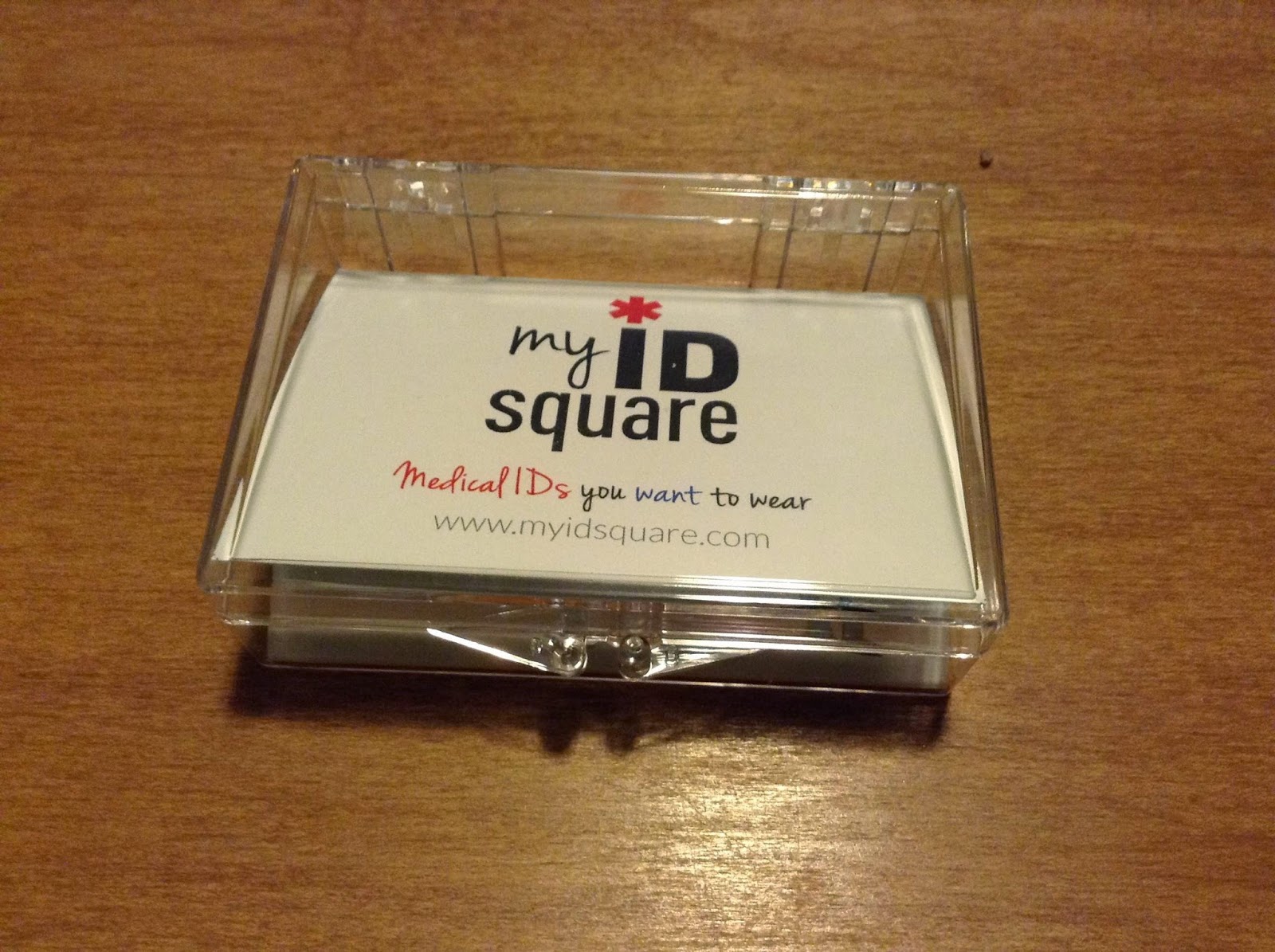
Today I am reviewing a medical alert product called My ID Square. 
  
I think that medical alert bracelets and other jewelry are essential for people with complicated medical issues.  I was first interested in such products when I was teaching and worried that if I wasn’t with someone who knew me, I needed something that would, in effect, speak for me if I could not communicate on my own, in a medical crisis or other type of an emergency.

I have tried many types of medical alert jewelry that are available, so I am excited that I am getting to try the My ID Square and adding it to my repertoire.

SquID squares (shown here), which can be attached to bracelets or necklaces, cost $47, which provides a lifetime subscription to the Emergency Medical Profile.  Squid Tags (dog tags) are $44, and also come with a lifetime subscription to the Emergency Medical Profile.     


In the Emergency Medical Profile, you can include date of birth, emergency contacts, allergies, medical devices and problems, medications, medical providers and insurance information, important dates, and any other information you want to include.  

Pros:

+ Made specifically for use as medical alert jewelry.

+ Love the packaging and the QR code concept.

+ The plastic QR part is colorful and probably great for kids.

+ Maintaining the Emergency Medical Profile database is built-in to the price of the ID, so you don’t have to pay a yearly fee for your information to be stored.

Cons:

- Not sure that this ID is great for professional, working adults.

- Has a small charm with a medical alert symbol and has a large one on the back of the part with the QR code, and since this concept might not be familiar to emergency responders, this might be overlooked.

- I am wondering whether all paramedics and medical personnel at hospitals are equipped with smart phones in order to read the QR code or even recognize that that is what it is.  I guess to circumvent this, the back of the ID has a web address and code so that it can be entered on the internet if a QR scanner is not available, but that sort of takes away from the concept.

- I don’t love the interface of the online database.  For example, there is no “boyfriend” option.  Additionally, I think because of this, when I attempted to make my boyfriend the primary contact, the system kept reverting back to my mom in the version that medial providers and first responders can see.  My mom is in Michigan and I’m in New York, so while she is definitely top on my emergency contact list, it doesn’t make sense for her to be the primary since we aren’t in the same state. 

- In order for your emergency contacts to be included, it requires that an e-mail or text message is sent to your contacts so that they can confirm.  I don’t really like this.  Other interfaces allow you to assign emergency contacts without requiring that they are contacted to confirm.  I worry that this could freak out unsuspecting people and they might mistaken it as an actual emergency.    

Overall, I think this concept is great and it’s a really innovative use of technology.  However, with many hospitals and medical providers just getting on the electronic medical records bandwagon, I worry that this might be too new for widespread use.

In other words, I love the concept, but am not so sure about the execution of it.

Thankfully, I have never been in a situation where my medical alert bracelet has been needed.  But I think that that’s really the true test of this product and others like it.  It’s great to have peace of mind on a daily basis by simply wearing a medical alert, but it’s more important to have that product work in an emergency situation.   

For more information, visit http://myidsquare.com/.      

And now through April 22, 2014, if you purchase a SquID, you can use the discount code GettingCloserToMyself15 and receive 15% off your order.

* My ID Square was generous enough to provide me with a SquID for free.  However, it was ultimately my choice to write a review, and has to do solely with my personal opinion of the product.

Wednesday, March 19, 2014

A Plea For A Chronically Ill Friend

I’m writing this post to ask for some help and support for a chronically ill friend.

This person has been a part of my support system from the very beginning, and was there for me when many of the people in my life could not or were not. 

My friend was one of the first people I connected with online, and the first blogger friend that I met in person. 

This person has celebrated my triumphs with me and helped guide me through the more difficult times. 

We now live on opposite coasts, and I couldn’t feel farther away from this person.  I feel like we are worlds away from each other, especially at a time like this.

I think that as chronically ill people, we sometimes think unconsciously that nothing else can befall us.  Or maybe it’s always in the back of our minds that we could become ill with something else, but it’s hard to imagine what life would look like in such a case.

I have always wondered with dread what would happen if I ended up with some other serious illness on top of lupus and RA.

But my good, good friend is now dealing with this situation as a reality. 

And my friend has a great attitude about everything that is going on and I deeply admire her courage and tenacity.

I am doing my best to support from afar, but I am asking that others send good vibes and thoughts this person’s way.   

I’ve lost several of the people that I have been closest to in terms of illness, both family members, and selfishly, I don’t want to go through that again. 

But unselfishly, my friend is so amazing and has so much to offer the world and I want them to be able to continue to do that for a very long time to come.

So I hope that, even though I am not saying exactly who this person is, others on the blogosphere can send collective good vibes.  That would mean a lot to me, personally, but I think my friend would really appreciate it, too.   

And to my friend, I say: You know how important you are to me and that I love you and am always here for you.  I hope that the journey you are embarking on is easier than we hope.  I hope that in the near future, this will all just be a blip on your radar, and nothing more.  And even though I live on the opposite end of the country, I will do anything I can to help, in person or from afar. 

And if there’s anyone who can power through, it’s you. 

Monday, March 10, 2014

Something’s Gotta Give

Rarely do I cancel anything.  But lately, I’ve become overcommitted.  This is, of course, and as many of you might expect, not unusual for me.  It is a skill that has worked for me in the past.  And when I was healthy, it was fine.  But now, it’s really not the best way to be.

Even though I’m chronically ill, I do think that there are times when I am coasting purely on adrenaline.  But instead of crashing and taking it easy for a day, as was required by my healthy self, my chronically ill self requires several days, sometimes even a week or two to regroup and totally recover. 

It’s a hard balance because so many amazing opportunities have come my way over the last several months.  And it’s hard to say no to things that I really want to be a part of.  But the reality is, for my physical and emotional well-being, I can’t do everything. 

Recently, I had a phone meeting scheduled for a new project I am hoping to become a part of.  But something had to give.  And at the moment, that was the easiest thing to put on the back burner.  I couldn’t get out of my school or current work commitments, so I looked at everything on my plate, and took off of it the must un-pressing thing.  Fortuitously, the person I was meeting with also happens to be chronically ill and completely understood where I was coming from, which was really great, and made postponing the meeting, even though in my heart I didn’t want to, much easier. 

And it made me realize that I have become more attuned to listening to my body.  My head was telling me that I needed to slow down and take it easy.  So I took two days.  I had only intended to take one, but one wasn’t enough.  So I took some time for myself, reading non-school related, junky reading, and rested, which put me in a much better place.    

When I used to not listen to my body, I ignored the signs, and didn’t stop until a flare was raging and I had absolutely no choice but to stop.  Clearly, that wasn’t ideal.  But now, I am better able to preempt a flare when it is caused solely by stress.  When I feel myself getting too stressed, or I get that feeling where I am always coming down with something but never get sick, I know it’s time to take a step (or two or three) back.

Recently, Chronic Illness Coach Rosalind Joffe wrote a blog post entitled, “the more i do, the better i feel.  sound familiar?

This is me in a nutshell.  Except the more I do, the better I feel is a hoax.  Like I said earlier, I might get an adrenaline rush from being active and doing a lot of things, but it’s a total rouse.  Because the minute I stop, my body shuts down.  It rebels against me, and then I am really at its mercy.   

It’s all about balance.  And when the balance starts to tip, well I really, really have to start to listening to my body and the signals it sends me. 

It’s good to listen before I send my body into a tailspin that leads to a flare. 

As we all know, stress exacerbates many chronic illnesses, and lupus and RA are no different.   

So how do you balance bouncing back and overdoing it?